
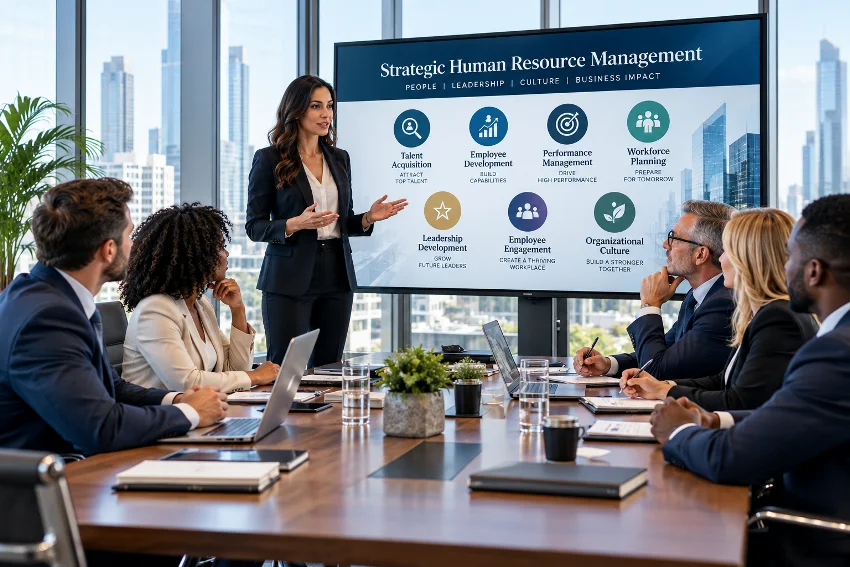
Great companies aren’t built on brilliant products alone. They’re built by people who know how to collaborate, innovate, and move toward a shared vision. That’s why Human Resource Management has evolved from an administrative function into one of the most important drivers of organizational success.
Today’s HR leaders do far more than manage recruitment, payroll, and employee policies. They shape company culture, develop future leaders, strengthen workforce capabilities, and connect people strategies with business objectives.
This guide explores the frameworks, technologies, leadership practices, and performance strategies that make modern HR management genuinely effective.
1. Understanding Strategic Human Resource Management
Traditional HR departments were often associated with administrative responsibilities, including employee records, workplace policies, compensation processing, and regulatory documentation.
These functions remain essential, but modern organizations increasingly expect HR teams to contribute directly to business strategy.
Strategic people management connects workforce decisions with long-term organizational priorities.
From Administrative HR to Strategic Business Partnership
Strategic HR involves understanding where a business wants to go and identifying the people, skills, and organizational capabilities required to get there.
Imagine a technology company planning to expand into three international markets.
A traditional HR approach might focus primarily on hiring employees after managers request additional positions.
A strategic HR team begins much earlier.
It evaluates future talent requirements, leadership readiness, regional employment conditions, compensation structures, and potential skill shortages.
This proactive approach helps the business prepare for growth instead of constantly reacting to staffing problems.
The Chartered Institute of Personnel and Development (CIPD) explains that strategic HR connects people practices and development with long-term business goals.
Aligning Workforce Strategy With Business Objectives
Effective workforce strategy should reflect the organization’s competitive priorities.
For example, a company pursuing product innovation may need strong collaboration, experimental thinking, and specialized technical expertise.
A manufacturing organization prioritizing operational efficiency may emphasize workforce safety, process improvement, and technical consistency.
Neither approach is universally superior.
The right strategy depends on the organization’s market, resources, culture, and business model.
HR leaders should regularly participate in executive planning discussions to understand how operational changes affect future workforce requirements.
This participation transforms HR from a supporting department into a meaningful strategic partner.
The Role of HR Leadership in Organizational Performance
Strong HR leadership requires commercial understanding alongside knowledge of employment practices.
Successful HR professionals can interpret business performance, communicate with executives, and translate complex organizational challenges into actionable workforce initiatives.
They also need the confidence to challenge decisions that could create unnecessary employee risks.
For example, an aggressive expansion strategy may appear attractive financially but become unrealistic without an adequate recruitment pipeline.
An experienced HR leader identifies these risks early and recommends practical alternatives.
Strategic influence develops when HR professionals consistently demonstrate how people-related decisions affect business outcomes.
2. Strategic Workforce Planning and Talent Acquisition
Hiring talented employees is important, but successful recruitment begins long before a job advertisement is published.
Strategic workforce planning examines the capabilities an organization currently possesses and the resources it may require in the future.
This approach helps companies identify skill gaps, control hiring costs, and prepare for changing business conditions.
Forecasting Future Workforce Requirements
Workforce planning involves analyzing employee numbers, occupational skills, organizational structure, and anticipated business demands.
Suppose a retail company plans to introduce an e-commerce operation.
Its future workforce may require digital marketers, logistics specialists, customer experience professionals, and data analysts.
Instead of immediately recruiting externally, HR can evaluate whether existing employees possess transferable skills.
Some workers may transition into new positions through targeted training.
Others may need additional certifications or professional development.
The Society for Human Resource Management (SHRM) identifies alignment between workforce capabilities and organizational objectives as an important element of strategic HR.
Skills-Based Hiring and Competency Assessment
Traditional recruitment frequently emphasizes academic qualifications and previous job titles.
However, these indicators don’t always reveal whether someone can perform a particular role effectively.
Skills-based hiring focuses more directly on demonstrated capabilities.
For example, a digital marketing candidate might complete a realistic campaign analysis rather than being evaluated solely on educational credentials.
A software development applicant could demonstrate technical abilities through a relevant coding exercise.
Assessments should reflect actual job requirements and follow applicable employment laws.
The U.S. Equal Employment Opportunity Commission warns that poorly designed selection procedures can create discriminatory outcomes even when employers don’t intend to discriminate.
Using standardized criteria and reviewing assessment results can help organizations improve both consistency and fairness.
Employer Branding and Candidate Experience
Employer branding describes how an organization communicates its identity as a workplace.
Candidates increasingly evaluate company culture, career opportunities, leadership quality, and employee experiences before accepting offers.
A compelling employer brand should reflect reality rather than simply presenting attractive marketing messages.
For example, promoting flexible work arrangements makes little sense if managers discourage employees from using them.
Recruitment processes should also be respectful and transparent.
Clear job descriptions, realistic hiring timelines, structured interviews, and timely feedback contribute to a positive candidate experience.
Even unsuccessful applicants may develop favorable impressions when the process is professional.
3. Employee Engagement, Organizational Culture, and Retention

Recruiting skilled employees is only the beginning.
Organizations must also create environments where people feel supported, understand expectations, and have opportunities to contribute meaningful work.
Employee engagement and organizational culture influence how teams communicate, solve problems, and respond to challenges.
Building a High-Performance Workplace Culture
Workplace culture includes the shared behaviors, values, expectations, and unwritten rules that shape everyday working experiences.
A company might claim to value collaboration while rewarding only individual achievements.
That contradiction can create confusion and weaken trust.
Strong cultures emerge when leadership decisions consistently reflect stated organizational values.
Managers play a particularly important role because employees experience culture through direct interactions with supervisors and coworkers.
HR leaders can support cultural alignment through leadership development, communication practices, and fair performance policies.
Employee Engagement and Business Outcomes
Employee engagement concerns the involvement, enthusiasm, and connection people experience toward their work.
Engaged employees typically understand their responsibilities and recognize how their contributions support organizational objectives.
However, engagement should not be confused with constant happiness or unlimited willingness to work.
Healthy engagement also requires sustainable workloads and appropriate organizational support.
Gallup’s State of the Global Workplace 2026 report found that only 20% of employees worldwide were engaged at work during 2025.
This finding highlights why engagement remains an important leadership concern across industries.
Organizations can improve their approach by examining employee feedback, manager effectiveness, role clarity, and opportunities for professional growth.
Retention Strategies Beyond Compensation
Competitive compensation matters, but retention depends on several interconnected factors.
Employees may leave because of limited career development, ineffective management, unclear expectations, or persistent workplace stress.
Rather than assuming salary is always the main issue, HR teams should investigate turnover patterns.
Exit interviews, stay interviews, and confidential feedback surveys can reveal recurring concerns.
Imagine that experienced employees frequently leave one department despite competitive salaries.
The underlying problem might involve poor managerial communication or inadequate advancement opportunities.
Addressing those issues may deliver more sustainable improvements than offering indiscriminate salary increases.
Psychological Safety and Employee Well-Being
Psychological safety refers to a workplace climate where people believe they can raise concerns, ask questions, and acknowledge mistakes without unnecessary interpersonal punishment.
This doesn’t mean removing accountability.
It means encouraging constructive communication while maintaining clear expectations.
Managers can support psychological safety by listening carefully, responding respectfully, and admitting their own mistakes.
Workplace well-being also requires attention to workload, reasonable flexibility, and access to appropriate support.
When employees feel respected and adequately resourced, organizations create stronger conditions for productive collaboration.
4. Performance Management and Leadership Development
Performance management should help employees understand expectations, improve their capabilities, and contribute effectively to organizational goals.
Unfortunately, many organizations still depend too heavily on annual evaluations that provide limited opportunities for meaningful development.
Modern approaches emphasize continuous conversations, measurable objectives, and supportive leadership.
Moving Beyond Annual Performance Reviews
Traditional annual reviews sometimes focus on ratings rather than constructive improvement.
Employees may receive feedback about problems that occurred several months earlier.
By that point, opportunities for immediate correction have already passed.
Continuous performance management introduces regular conversations about progress, challenges, and priorities.
The CIPD’s 2026 guidance emphasizes performance management as an ongoing cycle involving objectives, feedback, development, and changing business requirements.
For example, a monthly discussion can help an employee identify obstacles before those challenges affect an entire quarterly project.
Setting SMART Goals and Performance Indicators
Clear performance objectives help employees understand what successful work looks like.
The SMART framework encourages goals that are specific, measurable, achievable, relevant, and time-bound.
Consider a customer support department attempting to improve service quality.
A vague objective might be to provide better customer experiences.
A more useful goal could involve improving a defined customer satisfaction measure from 82% to 88% within six months, while monitoring service quality and workload.
The specific target should be based on credible baseline data and operational capacity.
Effective goals balance measurable results with behaviors that support long-term organizational health.
Coaching Managers Into Effective Leaders
Leadership development is not simply about sending managers to occasional training seminars.
It requires opportunities to practice communication, decision-making, conflict resolution, and employee development.
Coaching can help managers examine real workplace situations and improve their responses.
Mentoring offers another approach by connecting less experienced professionals with colleagues who can share knowledge and career guidance.
CIPD guidance recognizes coaching and mentoring as methods for developing employee capabilities when aligned with broader learning strategies.
Organizations should evaluate leadership programs through observable behavioral improvements rather than attendance alone.
Succession Planning and Leadership Continuity
Succession planning identifies employees who could potentially assume important roles in the future.
This process is particularly valuable when organizations face retirements, leadership transitions, or rapid expansion.
A succession plan should not simply name replacement candidates.
It should assess readiness, identify development needs, and establish practical opportunities for growth.
For example, a potential department director might temporarily lead a cross-functional project before receiving broader management responsibilities.
SHRM’s 2026 talent management guidance emphasizes leadership readiness and succession planning as components of workforce continuity.
Transparent development criteria can also help reduce favoritism and improve employee confidence in advancement opportunities.
5. Learning and Development for Future Workforce Capabilities
Employee development is increasingly important as technology changes job responsibilities and introduces new professional requirements.
Organizations that depend exclusively on external recruitment may struggle to maintain the capabilities needed for long-term growth.
A more sustainable approach combines hiring with internal learning and career development.
Identifying Organizational Skills Gaps
A skills gap occurs when existing workforce capabilities don’t fully match current or future operational requirements.
HR teams can identify gaps through competency assessments, performance conversations, project outcomes, and workforce analysis.
For example, a financial services company introducing AI-supported customer operations may discover that employees need additional knowledge of data interpretation and automated decision-making.
Not every employee needs advanced technical expertise.
Some roles may require foundational AI literacy, while specialists need deeper technical capabilities.
The World Economic Forum’s Future of Jobs Report 2025 estimates that 59 out of every 100 workers would need training by 2030, based on surveyed employers’ expectations.
This forecast demonstrates why workforce development should be integrated into strategic business planning.
Designing Effective Upskilling and Reskilling Programs
Upskilling improves capabilities within an employee’s existing career path.
Reskilling prepares someone to perform substantially different responsibilities.
Both approaches help organizations respond to technological and operational changes.
For instance, an administrative employee may develop data visualization skills and transition into a reporting specialist role.
Successful programs should combine relevant learning materials, practical assignments, manager support, and measurable outcomes.
The CIPD recommends aligning learning and development strategy with organizational objectives and regularly reviewing its implementation.
Training effectiveness should be measured through demonstrated skill application, not simply course-completion rates.
Building a Continuous Learning Culture
A learning culture encourages employees to develop new capabilities throughout their careers.
This can include structured training, collaborative projects, mentoring, professional certifications, and independent study.
However, organizations must provide realistic opportunities for learning.
Expecting employees to complete extensive training outside normal working hours may create frustration rather than motivation.
Managers should help employees connect development activities with meaningful career opportunities.
When people understand how learning contributes to their future, participation becomes more purposeful.
6. HR Analytics, Artificial Intelligence, and Digital Transformation
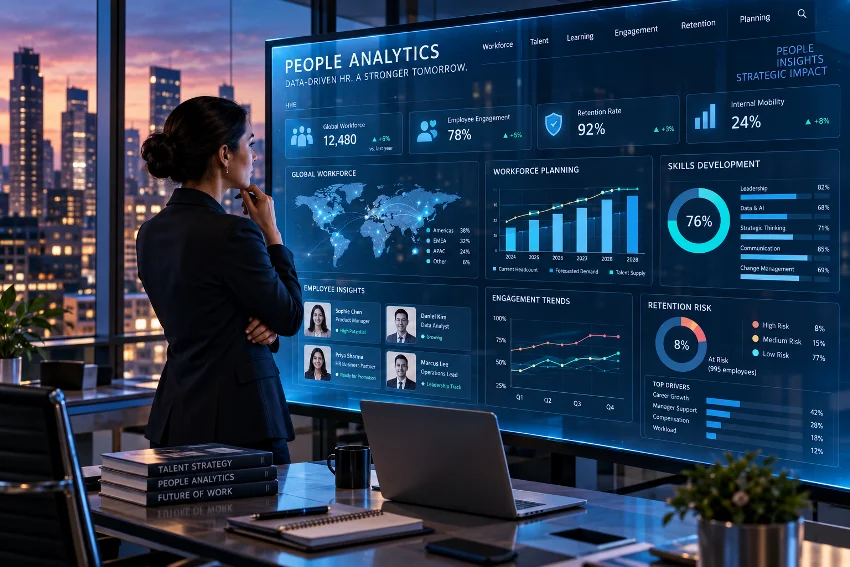
Technology is changing how organizations collect workforce information, manage employee services, and evaluate organizational performance.
Human Resource Management is increasingly supported by digital systems that simplify routine tasks and generate useful insights.
However, successful digital transformation requires thoughtful implementation rather than purchasing software simply because it offers advanced features.
Understanding People Analytics and HR Metrics
People analytics uses workforce information to investigate questions about employees, organizational processes, and business outcomes.
Common measurements include employee turnover, recruitment efficiency, absenteeism, internal mobility, and training effectiveness.
These metrics become particularly useful when connected with operational objectives.
For example, a business experiencing high employee turnover could examine differences among departments, managers, job types, and employee tenure.
The objective is to identify meaningful patterns that deserve further investigation.
Harvard Business Review has discussed how people analytics can extend beyond individual employee characteristics to explore organizational relationships and collaboration networks.
Analytical findings should support professional judgment rather than automatically determine important employment decisions.
Measuring HR Performance Through KPIs
A practical HR dashboard should prioritize indicators that contribute to organizational decisions.
Collecting hundreds of metrics creates little value when managers cannot explain what the information means.
The following indicators offer a useful starting point.
| HR Metric | Measurement | Strategic Purpose |
|---|---|---|
| Employee Turnover | Departures ÷ Average Headcount × 100 | Monitor Retention |
| Time to Fill | Days From Job Opening to Acceptance | Evaluate Hiring Speed |
| Internal Mobility | Internal Role Moves ÷ Eligible Employees | Assess Career Opportunities |
| Training Completion | Completed Training ÷ Assigned Training × 100 | Monitor Participation |
| Absenteeism Rate | Absent Workdays ÷ Scheduled Workdays × 100 | Identify Attendance Patterns |
| Employee Engagement | Consistent Survey-Based Measurement | Assess Workplace Experience |
These are illustrative measurement conventions. Organizations should define consistent reporting periods, eligibility rules, and calculation methods before comparing results.
ISO 30414:2025 provides requirements and recommendations covering human capital reporting areas such as recruitment, workforce composition, leadership, turnover, and employee development.
Using AI Responsibly in HR Operations
AI-supported tools can assist with recruitment administration, employee support, workforce forecasting, and document processing.
For example, automated systems may help organize applications or answer routine employee-policy questions.
However, automated recommendations can introduce privacy, accuracy, and discrimination risks.
A recruitment model trained on historical hiring patterns could potentially reproduce existing organizational biases.
HR leaders should evaluate data quality, model limitations, vendor claims, and applicable legal requirements before deployment.
The U.S. Equal Employment Opportunity Commission has emphasized that employers remain responsible for compliance with federal employment discrimination laws when using automated selection systems.
Responsible implementation should include meaningful human oversight and appropriate opportunities to review or challenge consequential decisions.
Protecting Employee Data and Organizational Trust
HR departments manage sensitive information relating to compensation, performance, employment history, and personal circumstances.
Strong data governance therefore requires appropriate access controls, retention policies, and clear internal responsibilities.
Organizations should avoid collecting personal information without a legitimate business purpose.
Employees also deserve understandable explanations of how relevant workplace data is used.
Digital transformation works best when efficiency improvements are balanced with privacy protection and transparent decision-making.
7. The Future of HR Leadership and Organizational Strategy
The future of HR will be shaped by technological adoption, changing workforce expectations, economic uncertainty, and evolving organizational structures.
Successful leaders will need to combine analytical capabilities with empathy, commercial judgment, and effective communication.
Rather than focusing exclusively on current staffing demands, forward-thinking teams must prepare for multiple possible business scenarios.
Managing Hybrid and Distributed Workforces
Hybrid and remote working arrangements introduce opportunities alongside new coordination challenges.
Employees may benefit from greater flexibility, while organizations can potentially recruit from wider geographical talent pools.
However, distributed teams require deliberate communication practices.
Managers should establish clear expectations, document important decisions, and evaluate performance through meaningful outcomes instead of physical visibility.
Organizations must also consider local employment requirements, information security, and appropriate collaboration tools.
An effective hybrid strategy reflects the nature of the work rather than applying one identical arrangement to every role.
Leading Organizational Change With Confidence
Business transformations often involve uncertainty about responsibilities, reporting structures, and future career opportunities.
Poor communication can amplify employee concerns and weaken trust.
HR leaders should help executives explain why changes are necessary, how decisions will be made, and what support employees can expect.
Two-way communication is particularly important.
Employees may identify operational risks that senior management has overlooked.
Involving relevant teams early can improve implementation quality and reduce avoidable disruption.
Developing an Ethical and Inclusive Leadership Approach
Responsible HR leadership requires fair decision-making, professional integrity, and respect for employee dignity.
This includes consistent policies, accessible development opportunities, and appropriate processes for resolving workplace concerns.
Organizations should also consider how different employees experience workplace systems.
A policy that appears neutral may create unintended barriers for particular groups.
Regular reviews, employee feedback, and transparent accountability can help identify these problems.
Ethical leadership should be evaluated through consistent organizational behavior rather than public statements alone.
Creating a Long-Term HR Leadership Roadmap
An effective people strategy should translate ambitious objectives into practical priorities.
For example, an organization might begin by evaluating existing workforce capabilities and identifying critical staffing risks.
The next phase could focus on improving leadership development, standardizing performance discussions, and strengthening internal mobility.
Later initiatives may introduce more advanced workforce analytics or technological improvements.
Each stage should include accountable leaders, realistic milestones, and relevant performance indicators.
The objective isn’t to launch every possible HR initiative simultaneously.
It’s to build a coherent system that continually improves organizational capability while supporting the people responsible for business success.
Strategic Human Resource Management connects workforce planning, talent development, leadership, and organizational culture with long-term business success. Effective HR leaders use evidence-based practices, modern technology, and ethical decision-making to build resilient teams.
Start by reviewing your current people strategy, identifying critical capability gaps, and improving one measurable workforce outcome. Small, consistant improvements can create meaningfull organizational results and support sustainble growth.